

Most cat owners have heard it: cats don’t need a collar, they always find their way home. Many do. But every year, lots of cats end up in a stranger’s garden, a neighbour’s garage or a shelter, and nobody can tell whose cat they are.
A dog wandering down the street is obviously lost. A cat sitting on a wall looks like it belongs there. That’s exactly why a cat needs a clear sign that it has a home, and a quick way for the finder to reach you.
In short: does a cat need an ID tag?
Yes, if your cat ever goes outside, and even if it lives indoors. Indoor cats slip out through open doors, windows and balconies, and they are the ones least prepared to find their way back.
The safest setup has three parts: a microchip registered in a database, a collar with a quick-release buckle, and a light ID tag that anyone can read with a phone. For cats, a flat tag that slides onto the collar is usually a better choice than a dangling one.
On the profile, put what the finder needs to act straight away: a photo, your phone number, a backup contact, and a note such as “Indoor cat. If you see me outside, I’m lost.”
In this article
- Why indoor cats get lost too
- Isn’t a microchip enough?
- Is a collar safe for a cat?
- Hanging tag or flat tag: which is better for a cat?
- What to put on your cat’s profile
- Should you put an AirTag on your cat?
- If your cat goes missing: the first steps
- Frequently asked questions
Why indoor cats get lost too
Indoor cats rarely get lost because they wander off. They get lost because something unusual happens:
- A door is left open while guests arrive or a parcel is delivered.
- A window is tilted open or the balcony net has a gap.
- Builders, painters or movers are in and out all day.
- You move house, and your cat tries to get back to the old place.
- The carrier opens on the way to the vet, or your cat panics at the clinic.
- Fireworks or a storm frighten your cat through any gap it can find.
An indoor cat outside for the first time is usually scared. It doesn’t run far: it hides, often just a few houses away, under a car, in a shed or behind bushes, and stays silent even when you call. Many are found by neighbours, not by their owners. That person needs to know straight away that the cat isn’t a local stray, and how to reach you.
Isn’t a microchip enough?
A microchip is essential. It’s permanent, it can’t fall off, and in some countries it’s mandatory for cats. But it has one big limitation: it can only be read with a special scanner, usually at a vet or a shelter.
The neighbour who finds your cat in the garden doesn’t have a scanner. Without a collar, they can’t even tell whether the cat has a home. Many people simply leave a cat alone, because they assume it’s an outdoor cat out on its usual round.
An ID tag takes care of the first step: it shows at a glance that the cat has an owner, and anyone with a smartphone can read it. The chip covers the case when the collar comes off. You need both.
Also check that the chip is registered and that your details in the database are up to date. A chip linked to an old phone number won’t help anyone.
Is a collar safe for a cat?
Yes, if it’s the right collar and it fits well. Cats climb, squeeze through gaps and jump through bushes, so the collar must be able to come off if it gets caught.
- Choose a collar with a quick-release (breakaway) buckle that opens under pressure. Avoid collars with a regular buckle that can’t open on its own.
- Fit: you should be able to slide two fingers under the collar. Too loose, and your cat can get a leg through it; too tight, and it rubs.
- Keep it light. Your cat should hardly notice the collar and tag.
- Check a kitten’s collar every week, as kittens grow fast.
- Get your cat used to it gradually: a few minutes at a time, at home first, with treats or play.
One honest downside: a quick-release collar does what it’s meant to do and sometimes comes off, tag and all. That’s another reason the microchip matters, and why it’s worth keeping a spare collar at home.
Hanging tag or flat tag: which is better for a cat?
For dogs, a hanging tag is the classic choice. For cats, a tag that sits flat on the collar is often more practical.
| Hanging tag | Flat, slide-on tag | |
|---|---|---|
| How it sits | Hangs from a ring under the chin | Slides onto the collar and lies flat |
| Getting caught | Can catch on branches or fences more easily | Nothing dangles, so it rarely gets caught |
| Noise | Can clink against the food bowl | Silent |
| Best for | Dogs, and cats used to collars | Cats, small dogs and very active pets |
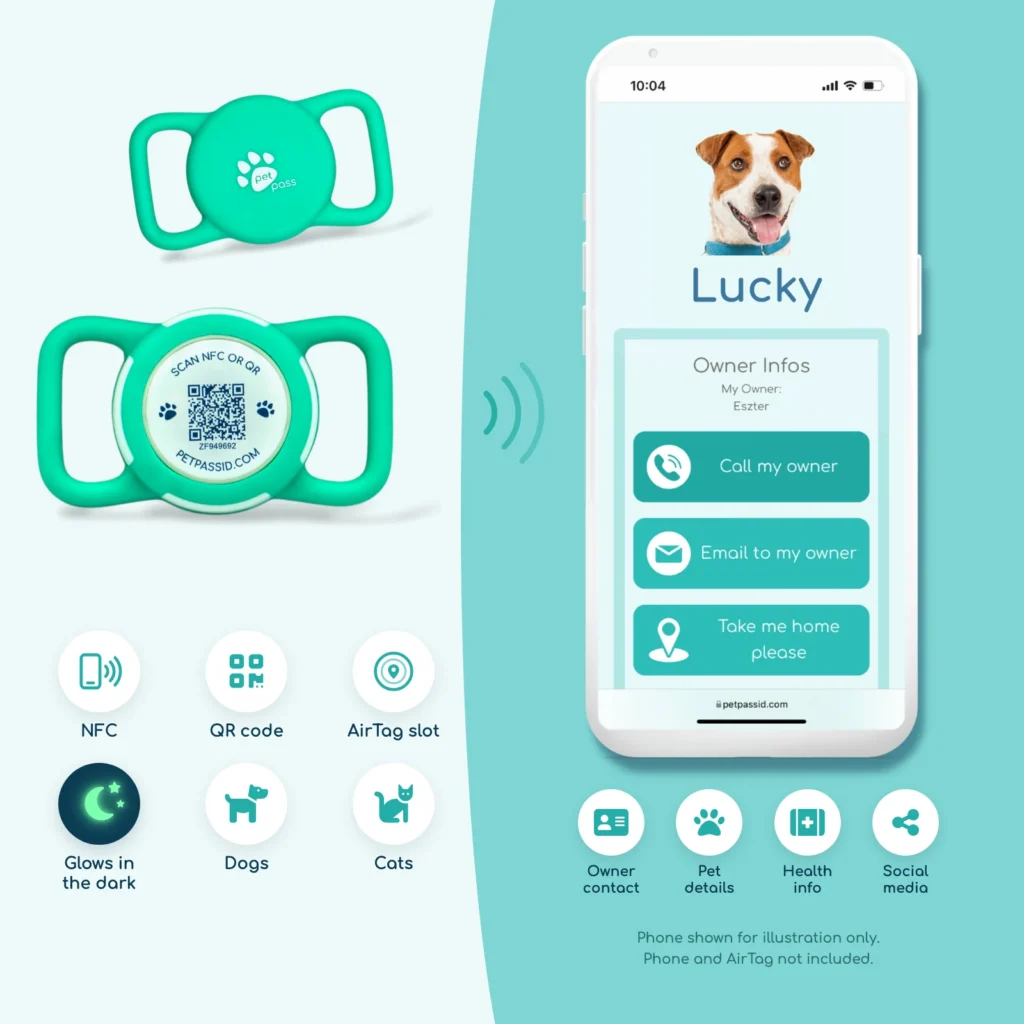
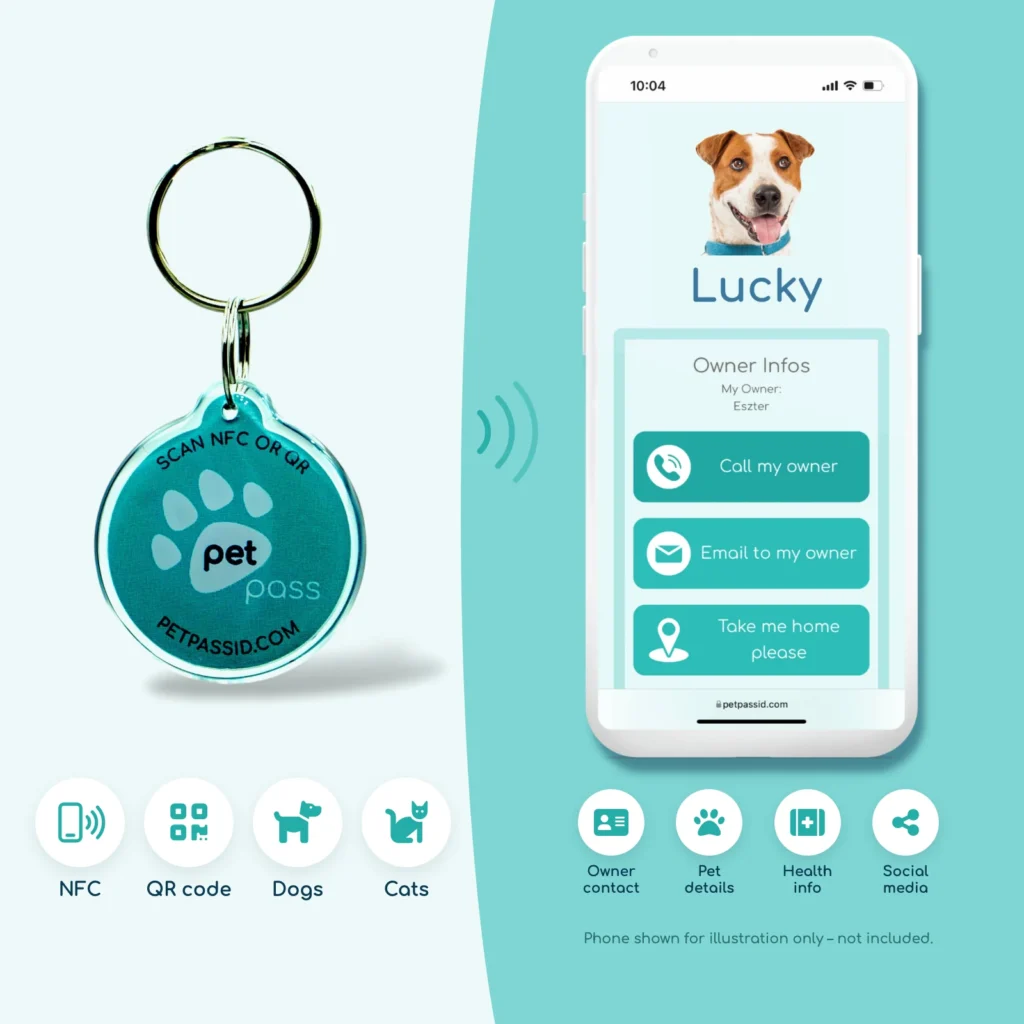
Pet Pass ID has both. The Smart Tag with NFC is a small, light hanging tag. The Smart Tag with AirTag Slot is a silicone tag that slides onto the collar (up to 2.0 cm wide and 0.5 cm thick), sits flat and glows in the dark. It works on its own too, with or without an AirTag inside.
Both have an NFC chip and a QR code. Whoever finds your cat taps the tag with their phone or scans the code, and your cat’s profile opens in the browser. No app is needed.
-
Pet Pass ID - Smart Tag with AirTag Slot
12 000 Ft -
Pet Pass ID - Smart Tag with NFC
8 000 Ft
What to put on your cat’s profile
Think of the person holding your cat: they need to know whose cat it is, who to call, and whether anything is urgent. Put these at the top:
- A clear, recent photo, ideally showing any markings.
- Your cat’s name.
- Your phone number, plus a second contact in case you can’t pick up.
- A short status note, for example: “Indoor cat. If you see me outside, I’m lost.”
Then add what helps the finder handle your cat safely:
- Health problems and medication, such as diabetes, kidney disease or a special diet.
- Behaviour: “Shy, may scratch when scared. Please don’t chase me, call my owner instead.”
- Whether your cat is neutered and microchipped.
- Your vet’s name and phone number.
Leave off what a stranger doesn’t need, such as your exact address or documents. With Pet Pass ID, you decide what’s visible, and you can choose to show certain details only when you mark your cat as lost. You can change everything online at any time, so the profile stays up to date even if you move or get a new number.
For a detailed checklist, read our guide: What should be on your pet’s ID tag and profile
Should you put an AirTag on your cat?
Many owners do, especially for cats that go outside. An AirTag can show where your cat was last detected by nearby Apple devices, which can narrow down the search. Keep its limits in mind, though:
- It isn’t GPS. Its location only updates when an iPhone or another Apple device passes nearby, so in quiet areas it may show nothing new for hours.
- You need an iPhone or another Apple device to see where it is.
- Apple designed it for items, not animals, and its anti-tracking alerts can notify people nearby that an unknown AirTag is moving with them.
- It helps you search, but it isn’t built to tell a finder whose cat it is. Most people who find a cat wouldn’t think of tapping an AirTag, while a visible QR code invites them to scan it.
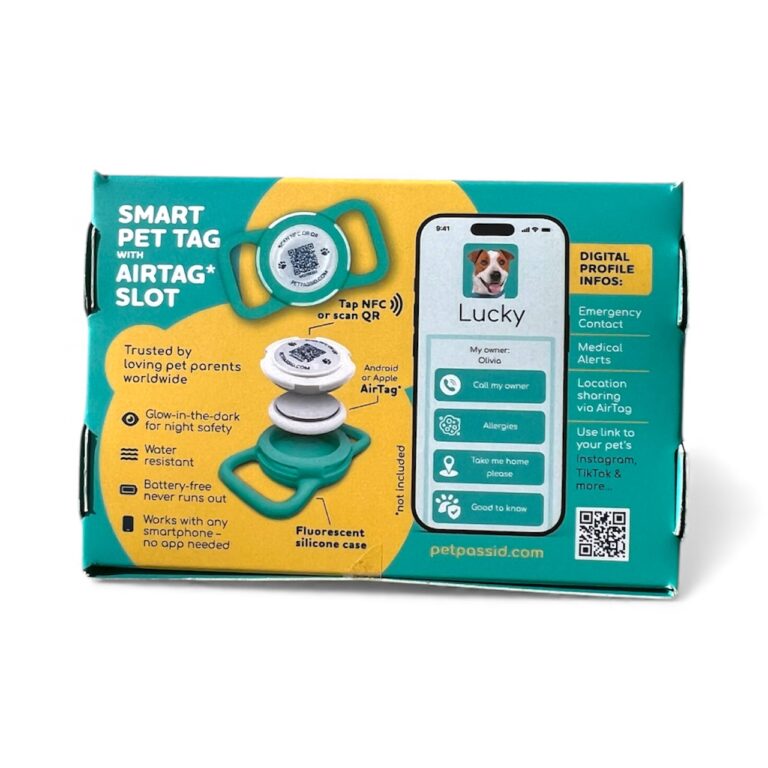
That’s why an AirTag and an ID tag work best together: the tracker helps you search, the ID tag helps the finder call you. The Pet Pass ID tag with AirTag slot combines the two in one flat tag.
We compare microchips, ID tags, GPS trackers and AirTags in more detail here: Microchip, ID tag, GPS or AirTag: which one actually helps?
If your cat goes missing: the first steps
- Search close to home first. Check under cars and in sheds, garages, cellars and bushes within a few houses.
- Search when it’s quiet, at dusk or at night, with a torch. Cats’ eyes reflect the light.
- Call softly, shake the treat bag, then wait and listen. Scared cats often stay silent.
- Mark your cat as lost in the Pet Pass ID profile, so the finder sees the right details straight away.
- Ask neighbours to check their garages and outbuildings, and post in local groups with a clear photo.
- Tell local vets and shelters, and check that your details in the microchip database are correct.
More tips for the first hours: What to do in the first 24 hours after your pet goes missing

Would a stranger know what they need to know about your pet?
Free 60-second safety check.
Pet Safety Check
✓ Takes about 60 seconds
✓ Personalized to your pet
✓ Get your Pet Safety Score
Free. No purchase required.
Frequently asked questions
Do indoor cats need an ID tag?
Yes. Indoor cats can slip out through an open door, window or balcony, and they are often the most frightened and the least likely to find their way home. A tag shows the finder straight away that the cat has a home and how to reach you.
Is a microchip enough for a cat?
No. A microchip is essential, but it can only be read with a scanner at a vet or shelter. An ID tag can be read by anyone with a smartphone. Use both.
What kind of collar is safe for a cat?
A light collar with a quick-release (breakaway) buckle that opens if the collar gets caught. You should be able to fit two fingers under it.
Which tag is best for a cat?
A light tag that doesn’t dangle. A flat tag that slides onto the collar is less likely to get caught and doesn’t clink. A small hanging tag also works for cats that are used to wearing a collar.
Can a finder read the tag without an app?
Yes. Pet Pass ID works with almost any smartphone: they tap the tag (NFC) or scan the QR code with the camera, and your cat’s profile opens in the browser.
Can I put an AirTag on my cat?
Yes, but it isn’t GPS, and it only updates near Apple devices. Use it together with an ID tag: the AirTag helps you search, while the ID tag helps the finder reach you.
Keep your contact details close.
Discover smart NFC and QR pet tags that connect a finder to your pet’s digital profile.
Explore Pet Pass ID tags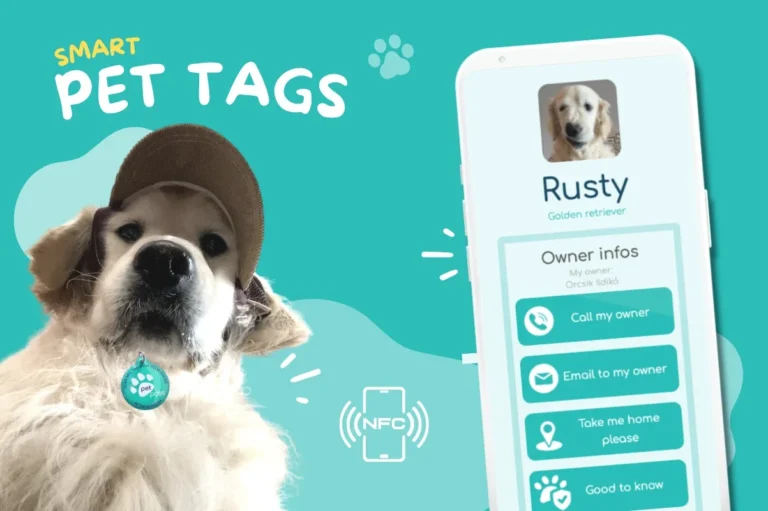




 English
 German
 Hungarian
 Spanish
 Italian
 French
 Polish
 Romanian